Disneyland Paris Map: Parks, Lands and How to Find Your Way
Use the Disneyland Paris map to plan your day: the two parks, the lands in walking order, where the headline rides and dining cluster, and how to arrive.
On this page
Disneyland Paris packs two gates, a dining and entertainment district and its on-site hotels into one compact resort about 32 km east of Paris, all arranged around the Marne-la-Vallée/Chessy rail station. That layout is the single most useful thing to understand before you unfold a park map: you are not crossing a city between areas, and the station sits a two-minute walk from the gates.
This Disneyland Paris guide works through the resort the way you will actually walk it, from the station and Disney Village through Disneyland Park's lands in order and then the second gate, so you can build a route that suits your group rather than zig-zagging. Whether you are travelling with thrill-seeking teenagers or a toddler in a pushchair changes which half of the map matters most.
What the Disneyland Paris resort map actually shows
The resort contains two theme parks, Disneyland Park and Walt Disney Studios Park, plus a restaurant and entertainment district and seven on-site hotels, and the whole complex opened in 1992. On a resort map these pieces read as one connected site: the two park entrances face each other across the Village side, and the hotels fan out along the lake and the approach roads behind.
The rail station is the anchor point to find first. It sits at the edge of the resort closest to the parks, which is why the walk from platform to turnstile is measured in minutes rather than in shuttle rides, and it is marked on general resort maps as the gateway point.
Group the map into three bands before you plan anything: the station and Village band at the front, the two park gates in the middle, and the hotel and lake band at the back. Any walking route you build for the day will move forward and back through those bands, and a short break of two or three days lets you cover each band without rushing.
How to read the official Disneyland Paris map
Disneyland Paris publishes its park overview maps on its own site, and that page is the version to work from for any given trip. Paper maps handed out at the gates and the maps inside the official app mirror the same layout, so a route planned on one will hold on the other.
Read the map in layers rather than all at once. First find the entrance and the hub, then trace the circular paths that loop around each park, then mark the two or three attractions you would genuinely queue for. Everything else on the map is a connector between those points, and the connecting paths matter as much as the rides when you have a pushchair or a tired walker.
If you want to see how the parks have changed over time, an interactive map that lets you slide between years shows which attractions stood where in each area. It is a useful orientation tool for understanding why some paths feel oddly long today, but it is not a substitute for the current official plan.
Disneyland Park: the lands in walking order
Disneyland Park opens onto a covered main street that runs straight from the turnstiles to a central hub, and almost every route in the park passes through that hub. Treat it as the map's compass: whichever land you are heading for, you can reach it from the hub without retracing the whole entrance street.
From the hub, the lands arrange themselves around the circle in a clockwise walk. Adventure and frontier-style areas sit to the left of the hub, fantasy and storybook areas to the right, and the discovery-style area sits at the back of the loop. Walking the circle in one direction rather than cutting across it saves the most ground if you want to see a bit of every land rather than commit to two.
The back of the park is where the map stretches out and where a loop pays for itself. If the day is warm and the front of the park is dense with families, starting with the rear-most lands and working forward puts you ahead of the flow instead of behind it, because most arrivals drift left towards the nearest big ride.
For your first hour, pick the land directly behind the hub rather than the one whose entrance you see first. Once you are two lands in, the paths between them are short enough to link three or four areas in a single sweep, which is exactly how the map is drawn to be used.
Walt Disney Studios Park: its areas and what each is best for
Walt Disney Studios Park sits directly opposite the Disneyland Park entrance, so the two gates are a short walk apart rather than a journey. That proximity is why a one-day ticket covering both parks is workable for a fast-moving group, and why you can switch parks at lunchtime without losing an hour to transport.
Inside the second gate, the map is more linear than Disneyland Park's loop. The front areas lean towards shows, behind-the-scenes style attractions and family rides, while the rear zones gather the larger thrill rides and the themed lands built around big-screen franchises. Plan the second gate as a push to the back and a slow return to the front rather than a circle.
That layout makes the Studios park the better choice for a half day with teenagers who want intensity, and the weaker choice for a group that wants to wander between gentle rides all afternoon. Parties that split over ride preferences can agree a meeting point at the front of the Studios park, which is compact enough to regroup quickly.
Studios has less shade and fewer of the long, tree-lined avenues you find in Disneyland Park, so a midday switch back to the main park is often the more comfortable plan when the sun is high.
Where the thrill rides and family areas sit on the map
Treat the map as a split between two kinds of day. The big, fast headliners cluster in the rear and side lands of both parks, while the gentle dark rides, carousels and storybook walk-throughs sit closer to the hub in Disneyland Park and closer to the front in the Studios park. Splitting a group along that line works far better than trying to keep everyone together all day.
Thrill-seekers should rope-drop the rear lands and work forwards, because the far side of the map fills later than the entrance area. Families with younger children should do the reverse: take the hub-side rides early while the park is calm, then drift towards the shows and characters when the paths get crowded.
Height rules decide some of these choices before you leave home, and they are listed on the individual attraction pages rather than on the map itself. Decide in advance which rides your youngest can join, and plan the day around those rather than around the headline names.
Ride order across a full day matters as much as ride choice. The standard pattern is one big rear-land ride at opening, a second before the middle of the morning, then a switch to shows and gentler attractions during the busiest hours, returning to the headliners in the evening when queues shorten.
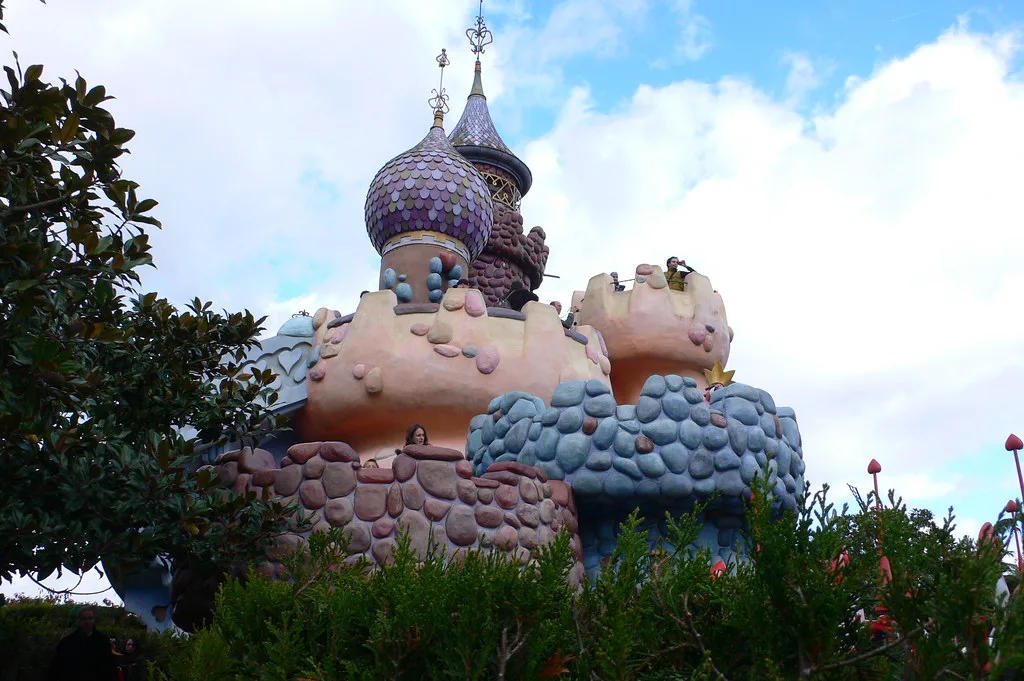
Disney Village: dining and the walking route between the parks and hotels
Disney Village is the district between the park gates and the hotels, and it is where the resort's evening life happens. On the map it is a single walkable strip rather than a separate destination, so you pass through it on the way from a park to a hotel and back again rather than making a special trip.
Use the Village as your dining fallback. Restaurants inside the parks fill around conventional meal times, while the Village gives you a wider spread of options a few minutes from the gates, and you can eat on the way back to the hotel at the end of the day rather than interrupting your ride time.
The Village is also the natural meeting point if your group splits between the two parks. Because it sits between both entrances and the hotels, regrouping there costs the least walking for everyone, and it is easier to find than a landmark deep inside a land.
Getting to the resort: RER A to Marne-la-Vallée/Chessy
The simplest arrival is the RER A from central Paris to Marne-la-Vallée/Chessy, a ride of roughly 40 minutes, with the station a two-minute walk from the park gates. That puts you at the turnstiles without a transfer to a shuttle or a taxi, and it makes the train the default choice for a day trip from the city.
You should still plan around the train's timetable rather than the map's. RER A runs on a suburban schedule, and late-evening return trains are less frequent than the peak service you used in the morning, so check the last services before committing to a closing-time exit.
Coach transfers from Paris hotels, and shuttle buses from the Paris airports, are the other common arrival routes. Both drop you at the resort rather than at the station, which shortens the final walk if you are carrying luggage for a multi-day stay.
Whichever route you take, the station is the landmark to navigate by. If you can find the station on the map, you can find the gates, the Village and the hotels from it.
Arriving by TGV and by road
The TGV station at Marne-la-Vallée/Chessy is part of the same station complex, so high-speed arrivals from other French cities and from abroad step off the train and join the same short walk to the gates. That makes the resort genuinely practical as a stop on a longer rail trip rather than a separate journey.
By car, the park entrances and the hotels are served separately, so the car park you choose should match your first stop. Day visitors heading straight for the gates want the main visitor car park, while guests staying at an on-site hotel should follow the hotel approach roads and leave the car for the duration of the stay.
Parking charges and the exact car park layout vary by visit and are published on the official site, so look there when you are budgeting the trip.
On-site hotels and Chessy as an off-site base
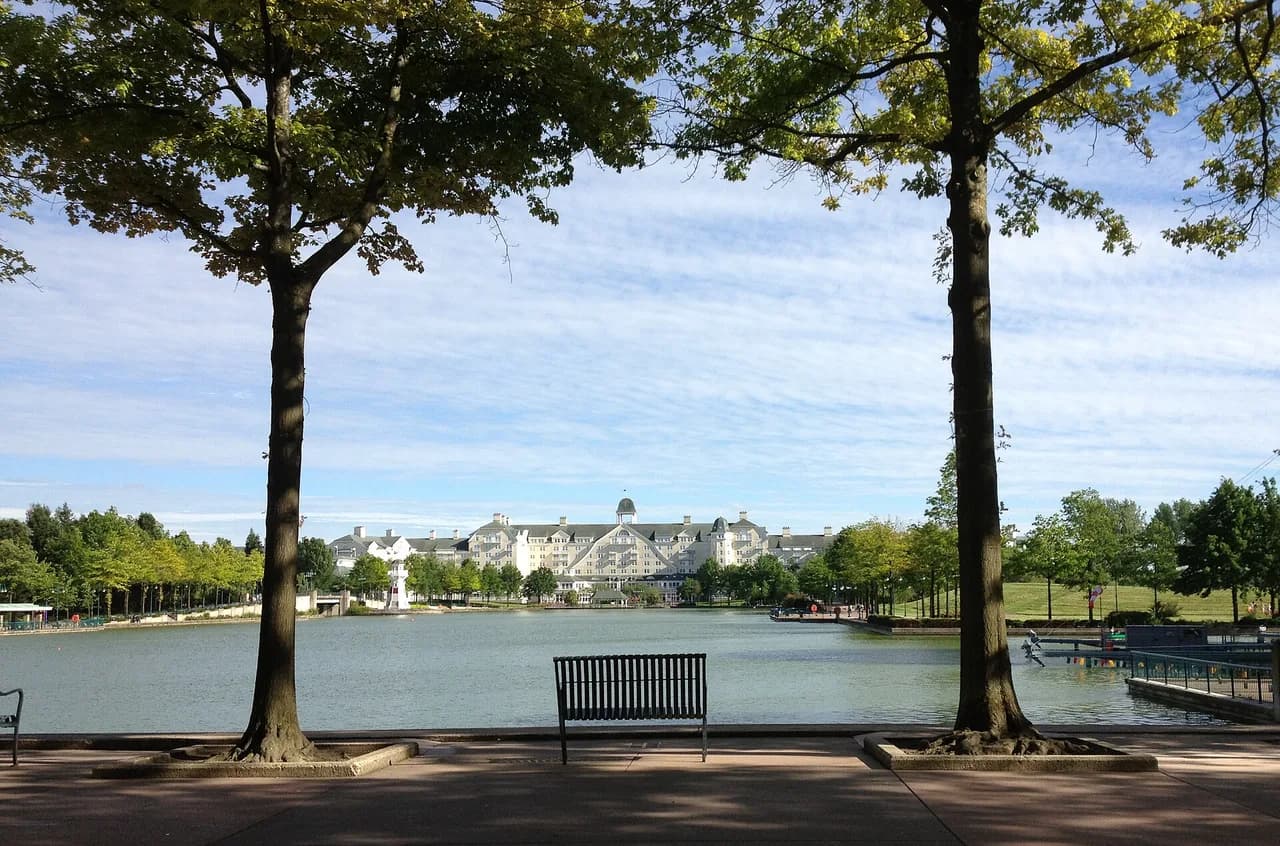
The on-site hotels sit on the resort map in a band behind the parks and the Village, reached on foot or by a short shuttle ride depending on which one you pick. The closest sit around the lake in front of the gates, while the further ones sit back along the approach roads and are better served by the resort's own transport.
Among the resort hotels, the Disneyland Hotel Paris holds the strongest ratings of the properties on the resort map and sits at the park entrance side, which makes it the pick if the shortest possible walk to the gates is the priority. The themed hotels further back trade that proximity for their own character and setting.
Off-site, Chessy sits just outside the resort boundary, inside the ring road formed by Boulevard de l'Europe, and offers apartments with private parking as an alternative to hotel rooms. It keeps you within easy reach of the station and the gates while giving you your own kitchen and space for a longer stay.
If you would rather be in the middle of the resort, the Davy Crockett Ranch sits apart from the main hotel band, which changes the walking maths: check exactly where any accommodation sits relative to the Village before you assume you can walk to the gates each evening.
Building a one-day walking route across both parks
A day across both parks only works if the map route is deliberate. Start at the station, cross the Village, and go through the Disneyland Park gate first, because the main park has the wider spread of attractions and the longer walks between them. Rope-drop a rear land, then work back towards the hub for the middle of the day.
Move to the Studios park for the early afternoon, taking in its shows and its front areas while the main park is at its busiest. The two gates are close enough that this is a walk, not a transfer, so you lose nothing in travel time and gain a fresh set of queues.
Return to Disneyland Park for the evening, when the daytime crowd thins and the front-of-park paths clear. Finish in the Village for dinner on the way back to the station or the hotel, which is the natural end of the loop on the map.
If you have more than one day, run the same loop in reverse on day two and swap which park you open. It costs you nothing and it spreads your walking across different parts of the resort.
Dining, toilets, baby care and accessibility points on the map
Facilities cluster where people enter and where they queue. Toilets and baby-care rooms sit near the park entrances and near the main hub of Disneyland Park, and the Village carries the largest concentration of them outside the gates. Mark them on your route before you need them, especially with young children.
Disneyland Paris publishes its accessibility guidance, including the arrangements for guests who cannot wait in a standard queue, through its visitor information pages. The official map page links to that material, and it is worth reading before you travel rather than at the gate.
For the wider trip, the resort works as one hub, which makes it easy to bolt on a day elsewhere in the region. If you want a second park day in France, a parc astérix map shows how differently a regional park is laid out, with coasters such as Pégase Express and La Trace du Hourra spread across distinct zones.
Further afield, a Futuroscope map shows a park built around a single wide lake rather than a circular hub, with rides such as Extraordinary Voyage and Objectif Mars in separate zones. Reading two different park maps side by side makes the Disneyland Paris layout feel obvious by comparison.
Plan Your Visit
Start with the resort shape: station at the front, two gates in the middle, Village and hotels behind. Get that fixed in your head and the individual park maps become easy to read, because you always know which way is back to the train or your room.
Then decide your split. Thrill-seekers should open in the rear lands, families should open near the hub, and every group should agree a Village meeting point before walking through the turnstiles. That is the whole planning job, and the map does the rest.
Explore more Disneyland Paris guides
Frequently Asked Questions
Where is Disneyland Paris on a map?
It sits about 32 km east of central Paris, at Marne-la-Vallée/Chessy, with the RER A station a two-minute walk from the park gates. Trains from central Paris take roughly 40 minutes, which makes the resort an easy day trip from the city as well as a base for a longer stay.
How many parks are at Disneyland Paris?
There are two theme parks, Disneyland Park and Walt Disney Studios Park, plus Disney Village and the on-site hotels. The two park gates sit close together, so a single day across both is realistic if you plan the route rather than drifting between them.
What is the best way to travel from Paris to Disneyland Paris?
The RER A from central Paris to Marne-la-Vallée/Chessy is the simplest option, taking about 40 minutes and dropping you a two-minute walk from the gates. Coach transfers from Paris hotels and shuttle buses from the Paris airports are the alternatives if you are carrying luggage.
How should I lay out one day across both parks?
Open at Disneyland Park and head for a rear land first, work back towards the hub through the middle of the day, then switch to Walt Disney Studios Park for the early afternoon. Return to the main park in the evening and finish in Disney Village for dinner on the way out.
Where do the on-site hotels sit relative to the parks?
They sit in a band behind the parks and Disney Village, with the closest arranged around the lake in front of the gates. The further hotels sit back along the approach roads and are better reached by the resort's own transport than on foot.
Sources
Notes for your next park day
Optional updates to our park guides.
You might also like
Continue reading
More guides you'll find useful